
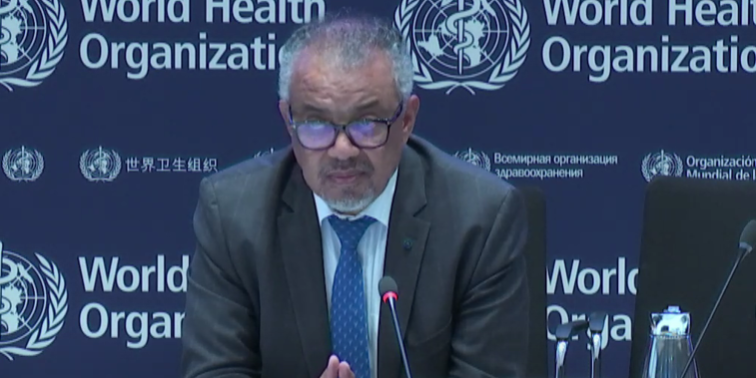
As is normal practice, the Co-Chairs displayed the Draft Report on the screen for comment. After it was agreed, the floor was handed over to the Director-General of the WHO, Tedros Ghebreyesus (DG).
The DG acknowledged that the progress made was disappointing but maintained that reaching agreement by the end of the year remains a possibility:
“I know you have made progress, but I also know from what you have being saying, it’s not as good as what we wanted.”
“But I still believe, despite the concerns you have, I still believe and many of you have said it, I think this negotiation can be concluded within this year. And would be important if it could be concluded within this year.”
At the end of his statement Tedros referenced the IHR negotiations stating that many sceptics did not believe consensus could be reached, but that ultimately it was:
“IHR people were sceptical if it was going to happen, but it did and that gave energy I think to this process. So I believe the same. I think we can do this same thing with the INB now. And it’s time.”
It is a widely held belief that the IHR was watered down in order to reach agreement to allow for adoption at the 77th World Health Assembly. Will such compromises be needed for the Pandemic Agreement to be agreed by November?
Argentina closed out the meeting with a statement on both national and personal sovereignty indicating that this topic remains of concern to some delegations:
“We are aware of the importance of the decisions to be taken especially as regards the possible interference with national regulation and legislation. We believe it is important for countries to maintain a margin in order to address this. As regards what was already expressed at the World Health Assembly, my country firmly believes that we need to implement an international instrument to tackle pandemics; it must be designed respecting the sovereignty of all states without exception. We must maintain the capacity to legislate and apply our own laws within our jurisdictions as we see fit with regard to the health of our citizens. We didn’t join the regional declaration. We will not allow for the individual liberty of any Argentinian to be impeded effecting our lives in the future. There can’t be any restrictions on the sovereignty of Argentina. We know that some will take issue with this, however, the agreement must be negotiated and many of its provisions must have imperative provisions but there are economic interests at play and there is influence. This means we have to express our position with regard to our national independence. Achieving agreement at any cost must be borne in mind and this is the architecture of our future and we are opting for our prosperity based on our national prosperity for the benefit of the future of our Argentinian citizens. Thank you.”
Pathogen Access and Benefit Sharing (PABS) system under Article 12 of the Pandemic Agreement remains contentious. Developing nations are not happy with the current draft text. These concerns are mirrored by many civil society organisations as is illustrated in a letter sent to the INB Co-Chairs on 16th September which can be read here in full.
Developing nations maintain that there can be no meaningful Pandemic Agreement without a robust PABS system. The framework for such a robust system remains elusive. Tough negotiations will be required in this area if consensus is to be reached this year.
Negotiations will continue.
You can listen to the short closing session here.
Next Steps
30 Sept – 21 Oct 2024: Informal meetings to be scheduled
4 – 15 Nov 2024: INB 12 (which could be the final meeting)
Goal
To reach agreement no later than the end of INB12 in order to schedule an Executive Board meeting followed by a special session of the World Health Assembly on a single issue – the adoption of the Pandemic Agreement in December 2024.
Latest drafts of the Pandemic Agreement
Unofficial:
https://www.keionline.org/wp-content/uploads/who-pandemic agreement-16Sep-17.30.pdf
Official:
https://apps.who.int/gb/ebwha/pdf_files/WHA77/A77_10-en.pdf


